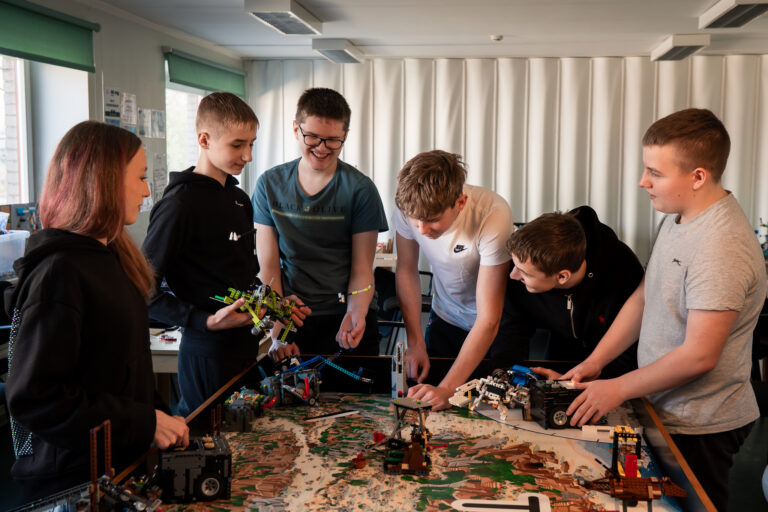
What if the landscapes around us were hiding stories from the past — and technology could help us uncover them?
This question became the starting point of our journey as a robotics team from Võrumaa, Estonia, participating in the FIRST LEGO League 2025–2026 UNEARTHED season. Over the past months, we explored how robotics, engineering, and artificial intelligence can be used not only to solve competition challenges, but also to tackle real-world problems.
Discovering the Problem
Our journey began with curiosity. As part of the UNEARTHED theme, we explored the world of archaeology — how discoveries are made, documented, and preserved.
We learned that archaeologists often rely on digital elevation maps to identify possible archaeological sites. However, analyzing these maps manually is time-consuming, subjective, and difficult to scale across large areas. This means that important historical sites can sometimes remain undiscovered.
This became our challenge:
How can technology help archaeologists find hidden traces of the past more efficiently?
Learning from Experts
To understand the problem better, we reached out to experts and explored the field beyond the classroom.
We spoke with archaeologists, including a researcher from the University of Tartu, who explained how archaeological work is carried out and why accurate mapping is essential. We also visited a museum, where we learned how findings are analyzed and presented to the public.
Later, we explored the role of artificial intelligence in archaeology. We discovered that AI can be trained to recognize patterns in data and could potentially be used to identify archaeological features in landscapes.
These insights helped us connect two worlds:
ancient history and modern technology.
Our Innovation Idea
Inspired by our research, we developed a concept for an AI-powered terrain analysis tool.
The idea is simple but powerful:
A user selects an area on a map, defines certain parameters, and the system analyzes digital elevation data to identify patterns that may indicate archaeological structures.
Instead of manually searching through vast amounts of data, archaeologists could receive a list of potential locations, making their work faster and more efficient.
This solution could help:
-
reduce the risk of missing important sites
-
analyze larger areas more effectively
-
support better preservation of cultural heritage
Designing and Building Our Robot
While working on our innovation project, we also designed and built a robot for the Robot Game.
Our goal was clear:
create a robot that is accurate, efficient, and reliable.
We built a compact, rectangular base robot designed for stability and precision. To complete different tasks, we developed multiple interchangeable attachments, each with a specific purpose.
Some attachments focused on:
-
lifting and grabbing objects
-
pushing and pulling elements
-
completing multiple actions with minimal movement
-
using pneumatic systems for precise control
Every design decision was tested, improved, and sometimes completely rebuilt.
Programming and Testing
Programming played a crucial role in our robot’s performance.
We used Python and Pybricks to create a custom control system, including:
-
a menu-based program structure
-
precise movement using gyro sensors
-
PID control for accurate driving and turning
But building the robot was only half the work — the real challenge was testing.
We ran our robot multiple times, analyzing every mistake and improving both the design and the code. Small adjustments often made a big difference, and through continuous iteration, we achieved more consistent results.
Strategy and Performance
In the Robot Game, time is limited, so strategy is everything.
Our approach was to:
-
complete as many missions as possible in one run
-
minimize unnecessary movement
-
design attachments that solve multiple tasks
Through testing and improvements, we worked towards achieving high scores while maintaining reliability.
What We Learned
This journey was about much more than building a robot.
We learned how to:
-
approach real-world problems
-
work as a team
-
test ideas and improve them
-
connect technology with other fields like archaeology
Most importantly, we learned that innovation starts with curiosity — and grows through persistence.
Looking Ahead
The UNEARTHED season showed us that the future of discovery lies at the intersection of technology and human curiosity.
Whether it’s exploring the past or building solutions for the future, we believe that young people have the power to create meaningful change.
And this is only the beginning.